

How To Set Up Tarp Under Tent
Sometimes y'all bring gear with yous to the campground but because your parents or your friends always did information technology that manner. This is how I felt about why to bring a tarp on a camping ground trip! I decided to compile a few reasons why you should consider bringing ane–some of which I've learned from personal feel, and some from research, then you can run into information technology all in one place.
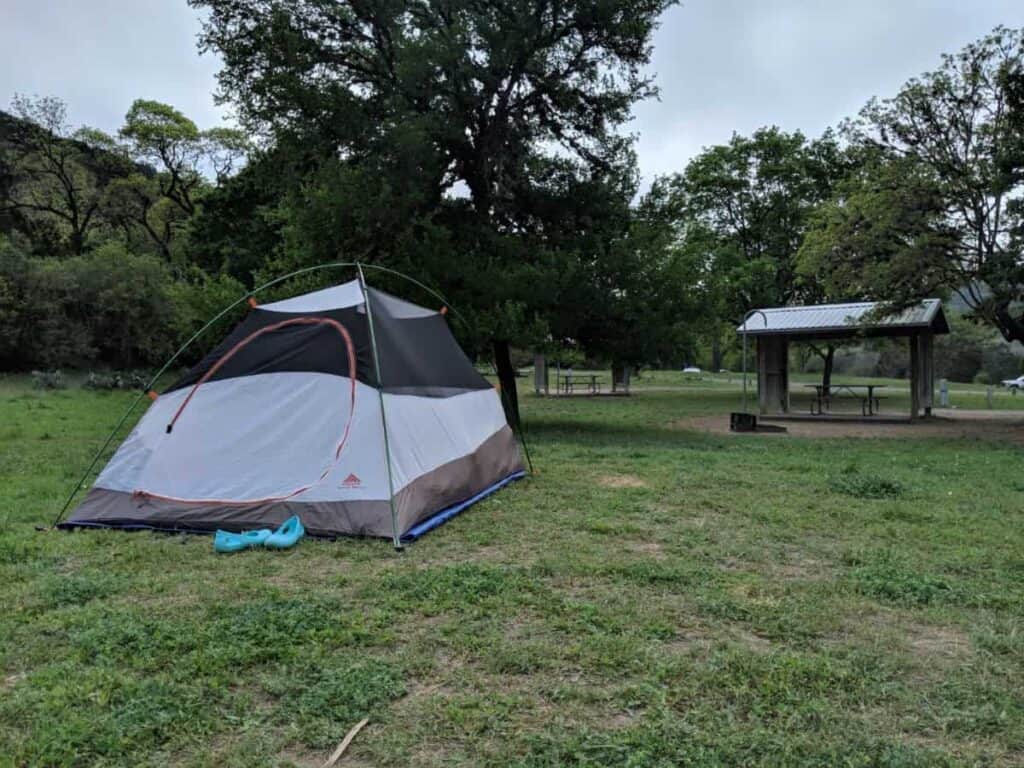
Practice I need a tarp underneath my tent? Although a tarp isn't necessarily the best available ground textile option for all circumstances, it is sufficient for most car campers. A tarp nether your tent protects the underside of the tent from wear and tear, nominally insulates, as well as prevents h2o from entering by acting as a wet bulwark.
Although information technology seems simple enough to just put a tarp nether your tent, there are some gotchas and fifty-fifty some differing opinions of whether it'due south a proficient idea in the offset place. Here are some reasons to consider toting a tarp forth with your tent, every bit well equally some guidelines of how to prevent water buildup.
By the way, as an Amazon Acquaintance, I earn when buying qualified products through links on my site.
Reasons to Put a Tarp Under Your Tent
Protect Your Tent
Sometimes your campground is going to have tent sites with a nice patches of green grass on gentle slope, with bugs that heed their own business organisation. I'm slightly exaggerating when I say sometimes.
Every other time, y'all'll exist on gravel, roots, clay, or even plain rock (in some Texas parks, you'll be sleeping on limestone!) It's non singular for car campgrounds to only allow you to put up a tent on a pad, or in some other designated area–and so yous don't always go to choose the perfect spot to prepare your tent.
When you lot're camping, your tent is your castle, and information technology becomes massively important to keep bugs and water out. Thus, whatsoever holes tin take unpleasant consequences, such equally unplanned roommates of the half-dozen to 8-legged variety.
Considering you are moving around (even slightly) while you are sleeping/packing/changing/spooky inside your tent, you are finer rubbing the underside of your tent confronting rocks, twigs, and roots. That friction can tear upwardly your tent.
Keeping a tarp underneath your tent is an extra layer of protection that volition extend the longevity of your tent.
Keep Out Moisture
Water, water, everywhere, merely please, not inside my tent.
Water condenses from the air when the air loses the energy that keeps water molecules apart. So when warm air cools down, h2o droplets will class. A glass of ice water on a hot day demonstrates this nicely.
The earth retains heat from the sun during the night, and when the temperature is the coldest (right earlier dawn) is when dew will form, because the warm globe is cooling off and is losing the energy to keep water molecules together.
Your tarp helps out in a few ways in this regard.
- Your tarp keeps your tent away from touching the dew covered ground. Yay!
- The tent can act as a vapor bulwark betwixt your tent and the ground, which can help prevent in-tent condensation.
- Your tarp tin protect yous from running water while it'due south raining (information technology's best to avoid pitching your tent where the land dips and water collects), and also from an already soaked ground
Keep your tent make clean
Sometimes, your campground doesn't have a lot of options, and the ground can be muddy.
Obviously, there isn't a contest afterwards your camping trip to see how clean your tent is, but keeping the outside of your tent clean is important, equally information technology makes information technology easier to bargain with–especially if you lot are going to be moving from identify to place.
Mud and glutinous pino needles can be a pain to take care of, and getting your tarp dirty is preferable because it is easier to wash.
Reasons Non to Bring a Tarp
A tarp or a basis cloth is probably in the unessential item category, considering it'southward VERY helpful simply in some situations, while in others it'southward only a overnice to accept. If you want to save infinite in your car camping ground kit, hither are some reasons why you might be okay without one:
- If you know your military camp is a soft bed and isn't likely to take unmovable, pokey, objects, and so you lot will be fine without a basis cloth
- If condensation is not a problem in your climate, or in other words, you are camping ground somewhere it doesn't go besides cold and it's not humid, then you may not need whatever moisture control
- Another detail to bring is another item to fold and stow abroad
- Camping in the sand. Sand will wick away whatever wet and is soft plenty that it won't crusade problems to the underside to your tent. Since sand is sand, later on all, you are going to need to clean our your tent after your trip no matter what you do (unless you are a post-campout-tent-shaking master). That existence said, if you have unpatched holes in the lesser-side of your tent, then maybe putting a tarp underneath will prevent that dreaded sand from getting all over the within of your tent faster than it inevitably will. Sand still is sand, after all
Why you Might Want to Bring One Anyway
If you aren't planning on using your tarp equally a ground cloth, make sure and bring some rope and your tarp tin help out in a couple of other awesome ways:
- If you are going to try sleeping in a hammock, then a tarp tin can be your but hope of staying dry. Using your tarp and some rope, you can suspend the tarp in an A shape to protect you from the rain. I had a groovy experience camping one night subsequently setting up a tarp over my hammock, and information technology rained several times that night. I did an okay task, considering I was by myself and wasn't as skilful at knots back then. Only 1 edge of my hammock got wet 🙂
- Tarps can be excellent wind shelters.
- Parachut… just kidding… don't try that.
Summary from Personal Experience
The campgrounds I've been to have had all sorts of terrain, and I've managed to stay dry (at least that I can remember) with my cheap blue tarp and my tent'due south pelting fly. I've been using the same tent for the past five years (less than $sixty), and I think I can attribute some of that success to my good ol' tarp.
Sometimes having another piece of gear to clean and maintain and fold is a bit of a hassle just it'southward been worth it so far. I've learned as well from researching for this post in that location'southward a lot of other methods out there, some ranging from no ground cloth at all, to using trash numberless! Don't call up as well hard near the perfect footing cloth treatment, since obviously many people detect success with varying methods. Keep adventure simple!
Related Questions
How big of a basis cloth should I get?
To proceed things simple, you can get a ground fabric that is slightly larger than footprint of your tent.
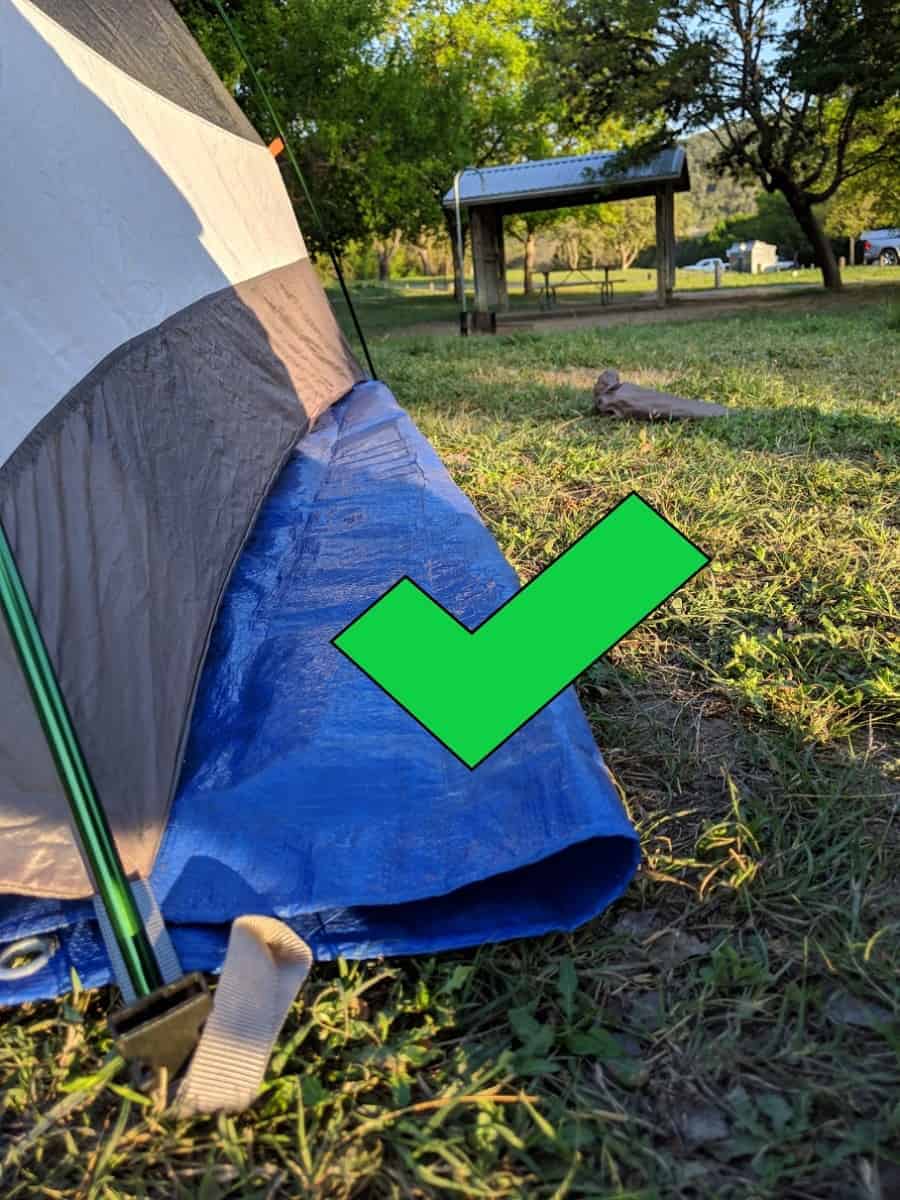
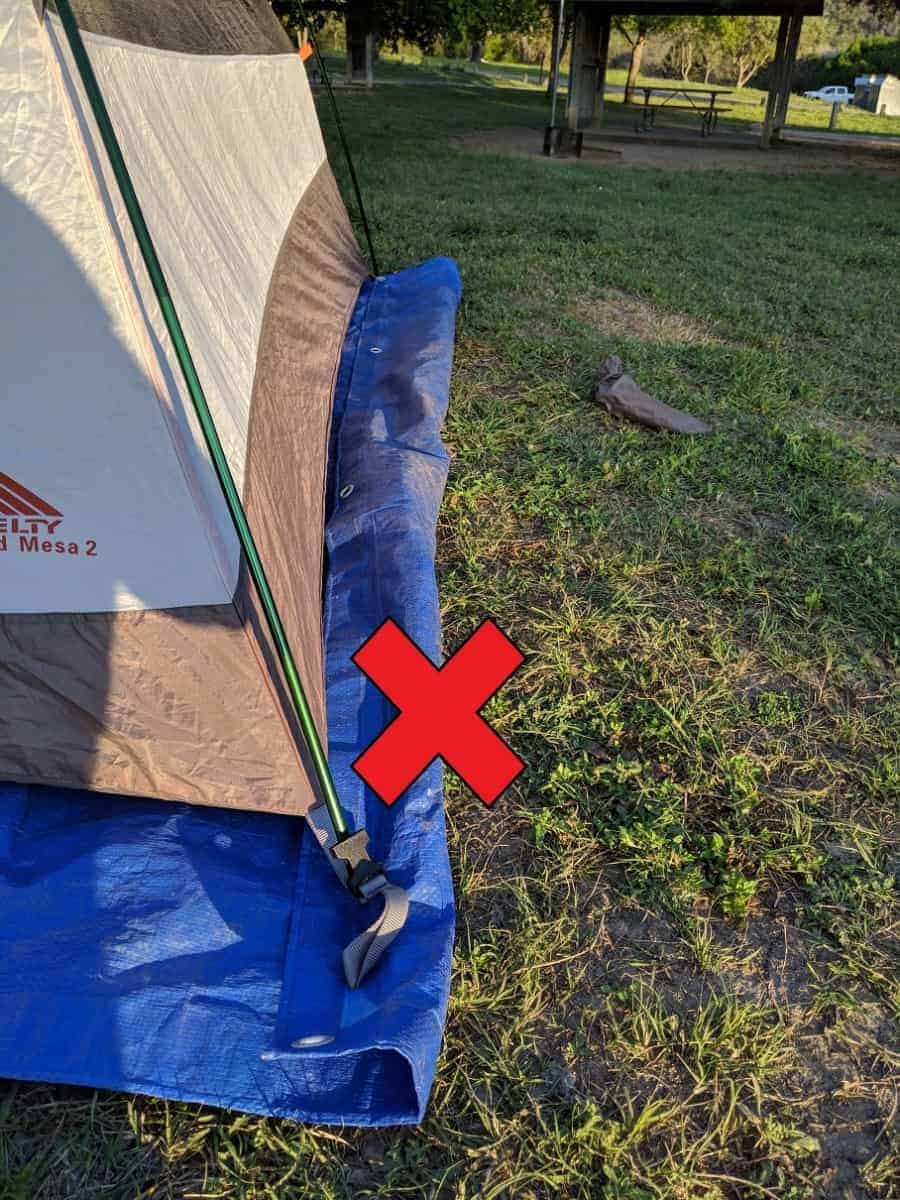
Note! Since your tarp is larger than the size of the tent and if you do not fold it properly, then you have created a picayune swimming! Brand sure and fold the tarp properly to ensure the water runs off.
Make certain to tuck the tarp in, with the edges folded underneath the tent so that the tarp matches the size of your tent (we're trying to go h2o to run from your tent and non to it).
Does information technology Matter Which Type of Tarp/Ground Cloth I Apply?
There are several options for "ground cloths". After researching this topic it I learned out there are dozens of materials that you lot tin use! Ultimately, your climate is what dictates how a item ground cloth will perform. If you lot're a beginner, I recommend going with a simple, cheap tarp so you lot can get camping.
Listed below are some common options for ground cloths:
Tent Footprints
Tent manufacturers will oftentimes make a "footprint" which is designed specifically to fit the dimensions of a particular tent. From my research, people have varying degrees of success with their footprint for moisture command and protection. Information technology'due south likely they vary in quality along with the tent. This is mostly the virtually expensive choice, and it's likely you tin can get some of the aforementioned benefits without the price using other options.
Tyvek
Tyvek is used equally a moisture barrier for houses. You lot've seen it before when a building is under construction before they put the siding on. Some campers use this as a barrier for their tents. This requires a piffling DIY since the material doesn't come in convenient rectangles handy for tents.
Painter'due south Drop Cloth
You can buy plastic painter's driblet material, used to collect paint, dust, and drywall debris when painting. Since it'due south essentially a sheet of impervious plastic, it will also work not bad for a waterproof barrier.
Tarpaulin (Tarp)
Ahh, the proficient ol' tarp. Tarps can be purchased from your local hardware store with varying thickness and weight. For occasional auto camping, a tarp that's in the medium thickness range will piece of work fine. In that location's no need to become the thickest tarp bachelor unless you lot will be camping on extremely rough surfaces regularly.
Source: https://decideoutside.com/do-i-need-to-put-a-tarp-under-my-tent/
0 Response to "How To Set Up Tarp Under Tent"
Post a Comment